

Product
Carbon & Price Aware API and MCP: same job, greener hour
Our Carbon & Price Aware API and MCP tell AI agents when the grid is cleanest and what a run costs. Runs that waited used 27% less CO₂ per kWh in Europe.

Take a job set to run at two in the morning. On 8 October in Germany, the same hour of work at three in the afternoon would have used 49% less CO₂ per kWh: 220 grams instead of 433. On 28 October in California, ten in the morning beat two at night by 57%: 136 grams instead of 316.
Nothing about the job changed. Only the hour did.
That is the idea behind the GreenPT Carbon & Price Aware API and MCP. Before an AI agent starts a run, it asks GreenPT one question: is now a clean moment? If it is, the job runs. If a cleaner hour is coming before its deadline, it waits, then runs once.
Transcript
Your AI agents run on a schedule. But the power grid changes by the hour. Sun and wind cost almost nothing to run, so the grid uses them first. When they fade, gas and coal fill the gap. So every hour has a different carbon footprint. Take a job set for two in the morning. On this day in Germany, three in the afternoon was 49% cleaner. In California, ten in the morning was 57% cleaner. So before every run, your agent asks GreenPT one question: is now a clean moment? If it is, the job runs. If a cleaner hour is coming, it waits, then runs once. A run is never blocked. What does that save? When a run waits, it typically emits 27% less CO₂ in Europe, and 21% less in the United States. For jobs that can wait, that goes up to half. GreenPT also knows what the AI costs. The same work, run as a batch within a day, costs half. It is live for Microsoft Foundry, coming to AWS Marketplace for Amazon Bedrock, and in private beta as an MCP and API. You see every run and what it saved, with reports for CSRD. Set-up takes one click. And every moved run is on record. Same job. Greener hour. Known cost. That’s GreenPT. The Carbon Aware API and MCP are now in private beta. Scan the code to learn more.
Why we built it
We have thought a lot about how GreenPT can have a large influence on AI, and on agentic AI in particular. Multi-purpose generative models can use around 30 times the energy of models built for a single task: on question answering, Luccioni, Jernite and Strubell measured about 10 g CO₂e per 1,000 answers against about 0.3 g. Agents run on those models, many times a day.
Many companies run whole fleets of agents. Most of them will stay on the platform they chose, for good reasons, and won’t move to GreenPT. So we built something that works where their agents already run.
The grid changes by the hour
Sun and wind cost almost nothing to run, so the grid uses them first. When they fade, gas and coal fill the gap. That is why the carbon intensity of electricity, the grams of CO₂ per kWh, rises and falls through the day.
A chat answer has to come now. A lot of agent work doesn’t: a nightly report, a weekly analysis, a batch of summaries, data enrichment, an eval run. It needs to be done by a certain time, not started at a certain minute. That slack is what the API uses.
One question before every run
A carbon-aware agent gets a deadline instead of a start time. Before it runs, it asks for the cleanest window before that deadline:
curl "$CARBON_API/best-window\
  ?location=us-west-1\
  &duration_minutes=60\
  &deadline=2026-11-10T13:00:00Z" \
  -H "Authorization: Bearer $GREENPT_KEY"
This is a real answer, from 9 November 2026 at 13:39 UTC, trimmed to its main fields:
{
  "run_now": false,
  "start": "2026-11-09T20:00:00Z",
  "gco2_kwh": 121.2,
  "if_run_now": 329.7,
  "saving_pct": 63.2,
  "wait_minutes": 382,
  "kind": "forecast",
  "zone": "US-CISO"
}
Its summary field says the same in one sentence, ready for an agent to pass on: “Wait 6h22m and start at 2026-11-09 20:00 UTC on the US-CISO grid: 121.2 instead of 329.7 gCO2/kWh, 63.2% less CO2, 208.5 g saved per kWh.”
The same question for eu-central-1, at the same moment, came back run_now: true: no later hour before the deadline was cleaner than Germany’s grid at that moment. We picked these two regions to show both kinds of answer, so they are examples, not averages.
Three rules make waiting safe:
- The deadline holds. Every window ends before it. When no later hour is cleaner than now, the answer is
run_now: true. - It fails open. When there is no forecast, or GreenPT can’t be reached, the run goes ahead. Missing data never blocks work.
- Small savings don’t wait. The gates in Foundry and Bedrock only move a run when it saves at least 5%, and never by more than 8 hours, unless you set other limits.
What it saves
We replayed every measured hour from 5 October to 5 November 2026, on 6 EU countries and 7 US grids. For each start hour, we compared a one-hour job run straight away with the cleanest start in the next 8 or 24 hours, and counted only runs where moving saved 5% or more.
Less CO₂ per kWh for a run that moved. Median, with the range of the middle 8 in 10 runs.
| Grid | Up to 8 h | Up to 24 h |
|---|---|---|
| Europe, 6 countries | 18% (7–44) |
27% (9–53) |
| Netherlands | 23% | 40% |
| France | 23% | 35% |
| Germany | 20% | 31% |
| Poland | 18% | 24% |
| Italy | 17% | 21% |
| Sweden | 13% | 15% |
| United States, 7 grids | 14% (6–41) |
21% (8–50) |
| California | 41% | 45% |
| Texas | 23% | 34% |
| Great Plains | 15% | 26% |
| Arizona | 12% | 19% |
| Midwest | 12% | 17% |
| Northwest | 12% | 15% |
| Virginia | 9% | 12% |
The saving is largest where sun and wind swing hardest, like California and the Netherlands. Where the grid is clean all day, as in Sweden, there is little to gain, and the honest answer is that the hour barely matters.
Two things to keep in mind when you read these figures:
- They are a best case. They use hindsight. A real run decides on a forecast. In a 30-day US backtest from September 2026, the forecast caught 66% to 96% of the achievable saving for a one-hour job, depending on the grid.
- Europe can see less far ahead. The day-ahead forecast is published once a day, so at 14:00 UTC on 6 November the API could see 9 hours ahead for the Netherlands and Germany, against 25 hours for US grids. At moments like that, the 24-hour figures are out of reach.
These are average intensities, which is what GHG Protocol reporting uses. So we say a run uses less CO₂ per kWh, not that it removes CO₂ from the grid.
An API and an MCP server
The Carbon & Price Aware API is a REST service, and the same tools are served over MCP, so an agent can call them without any HTTP glue.
| Endpoint and MCP tool | Question it answers |
|---|---|
GET /carboncarbon_intensity |
How clean is the grid here, hour by hour, measured and forecast? |
GET /best-windowbest_window |
When should this job run, before its deadline? |
GET /best-locationbest_location |
Where, and when, should it run, given several regions? |
GET /pricesllm_prices |
What does this model cost at each provider, cloud and router? |
GET /regionslist_regions |
Which cloud region names can I pass as a location? |
GET /zoneslist_zones |
Which grids are covered? |
You can ask by coordinates or by cloud region name, such as westeurope, eu-central-1 or us-west-1, so an agent scheduling a cloud job needs no coordinates. The MCP server is stateless streamable HTTP with the same bearer key as the API, so it works in any host that lets you set a header, such as Claude Code, Cursor or the MCP SDKs:
claude mcp add --transport http \
  greenpt-carbon "$CARBON_API/mcp" \
  --header "Authorization: Bearer $GREENPT_KEY"
The server also tells the model how to use it: decide when with best_window, trust measured values fully, treat forecasts as predictions with uncertainty bands, and relay the one-sentence summary as it is.
A price on every run
Carbon is one half of the question. The other half is money. The API keeps token prices per model up to date across providers, clouds and routers, batch prices included. Give it a model and a token count, and a run has a price before the first token is spent.
On 6 November 2026, one million input tokens and 200,000 output tokens on Claude Sonnet 4.5 cost $6.00 on Amazon Bedrock, $6.60 through an EU or US inference profile, and $3.00 as a batch. The same work on GPT-5 in Azure cost $3.25, or $1.63 as a batch.
A batch API costs about half, but the provider picks when it runs within about a day, so when you submit it doesn’t change its carbon. For a job you run yourself, best_window decides when. For a model on Bedrock, Vertex or Azure, the region is the lever: compare that cloud’s regions with best_location.
Where it works
Microsoft Foundry
For Foundry agents, GreenPT is a tool the agent calls at the very start of a run. The agent signs in with its own Microsoft Entra identity, so there are no API keys. When a later start saves at least your minimum, GreenPT creates a one-shot routine in your Foundry project that starts the same task once, at the greener time, and tells the current run to stop. A moved run is never moved again.
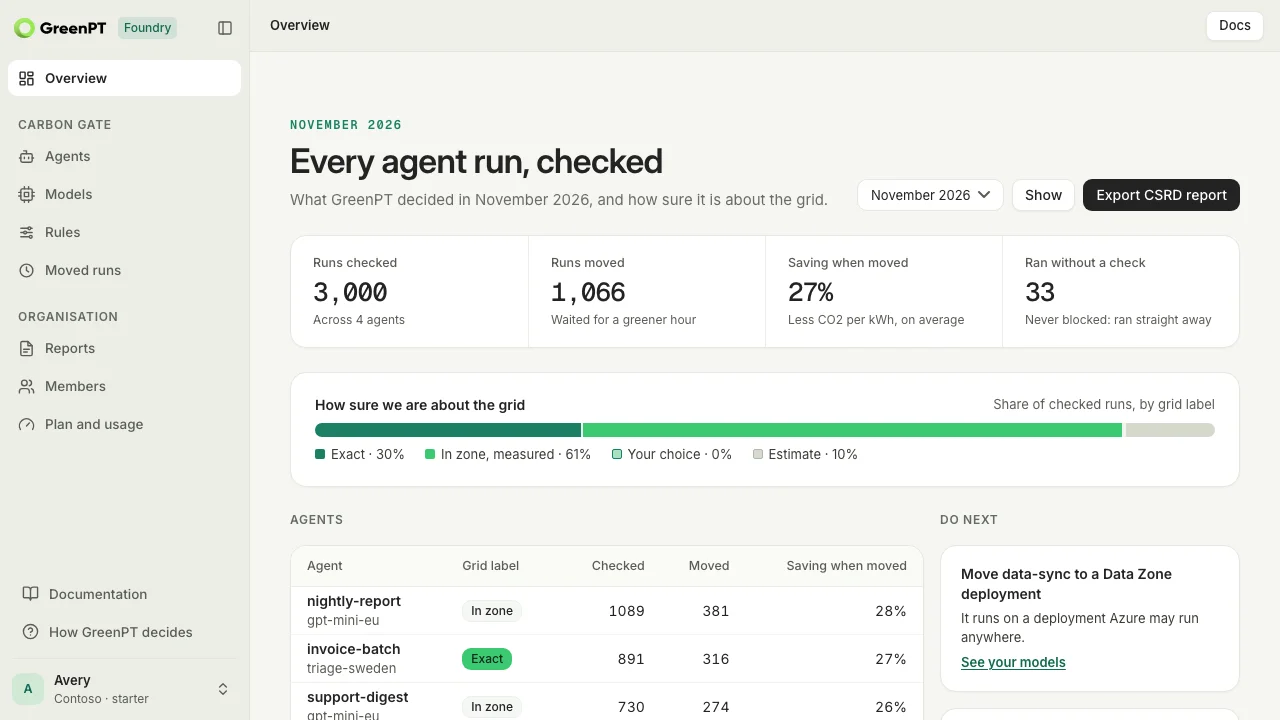
Every agent run, checked: what GreenPT decided this month, and how sure it is about the grid. Illustrative data for Contoso, a fictional company.
GreenPT sets the agents up for you. It adds the tool and one instruction line in Foundry, after you review the change, and shows which agents are ready.
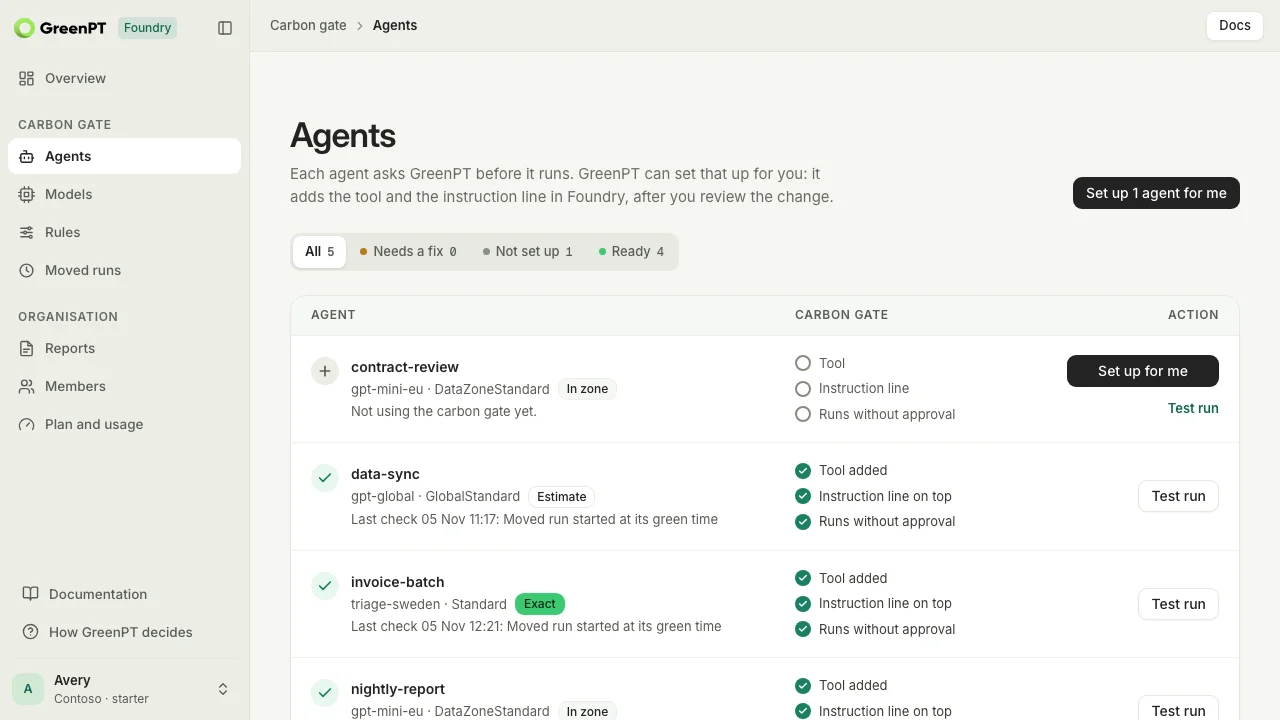
Each agent’s set-up at a glance. Illustrative data for Contoso.
Where a model runs decides which grid counts. In Azure, that depends on the deployment type, and GreenPT labels each one honestly: exact for a regional deployment kept in one country, in zone for a Data Zone deployment, and estimate for a Global deployment that may run anywhere.
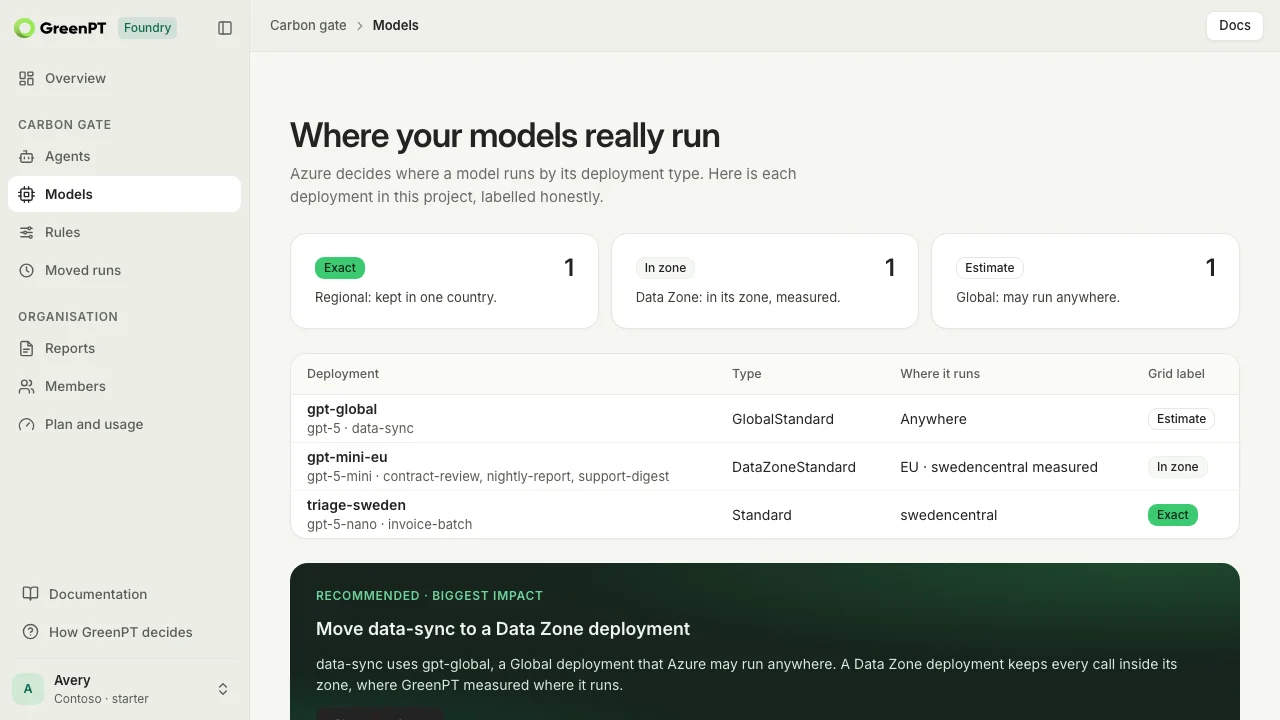
Where your models really run. Illustrative data for Contoso.
Every moved run is on record, with its saving and its grid label, and the monthly report is ready for CSRD.
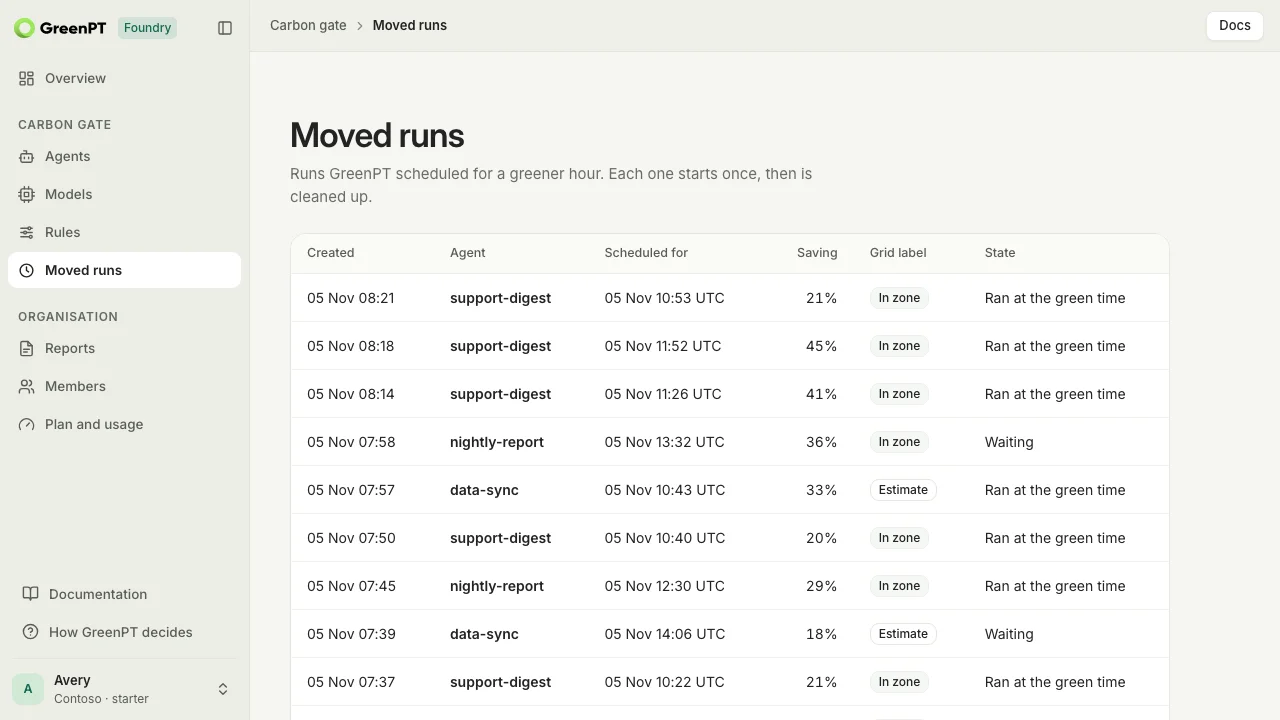
Runs moved to a greener hour. Each one starts once, then is cleaned up. Illustrative data for Contoso.
Amazon Bedrock AgentCore
For AgentCore agents it works the same way. The agent proves who it is with its own AWS identity token, and a moved run becomes a one-shot EventBridge Scheduler schedule in your account, which starts the task once and then deletes itself. Set-up is one CloudFormation stack with two roles and a schedule group, and each step turns green when AWS confirms it.
Transcript
Your Amazon Bedrock agents run on a schedule: nightly reports, digests, batch jobs. Most of them don’t need to start at an exact minute. But the power grid isn’t equally clean all day. On this day in California, a job set for two in the morning would have used 57% less CO₂ per kilowatt-hour at ten. GreenPT gives each AgentCore agent one tool. At the start of a run, the agent asks: is now a clean moment? If it is, the run goes ahead. If a cleaner hour is coming, GreenPT moves it there. The agent signs in with its own AWS identity, so there are no keys to manage. When a run moves, GreenPT sets a one-shot schedule in your account. It starts the same task once, at the greener time, then deletes itself. You set the limits: how long a run may wait, and the smallest saving worth waiting for. If GreenPT can’t check, the run simply goes ahead. Set-up is guided, step by step: pick your regions, grant access with one CloudFormation stack, and add the tool to each agent. Each step turns green when AWS confirms it. GreenPT also tells you how sure it is: exact when a model runs in one region, in zone for EU and US inference profiles, and an estimate for global ones. Every decision is on record: what ran, what moved and what it saved, with a monthly report for CSRD. When a run moves, it typically uses 18% less CO₂ per kilowatt-hour in Europe and 14% in the US, with the default eight-hour wait. Allow a day, and that rises to 27 and 21%. Plans start at 49 dollars a month for ten thousand checks, on your AWS bill. You see what’s used, and you can stop at what’s included. Same job. Greener hour. GreenPT Carbon-Aware for Amazon Bedrock AgentCore, now on AWS Marketplace.
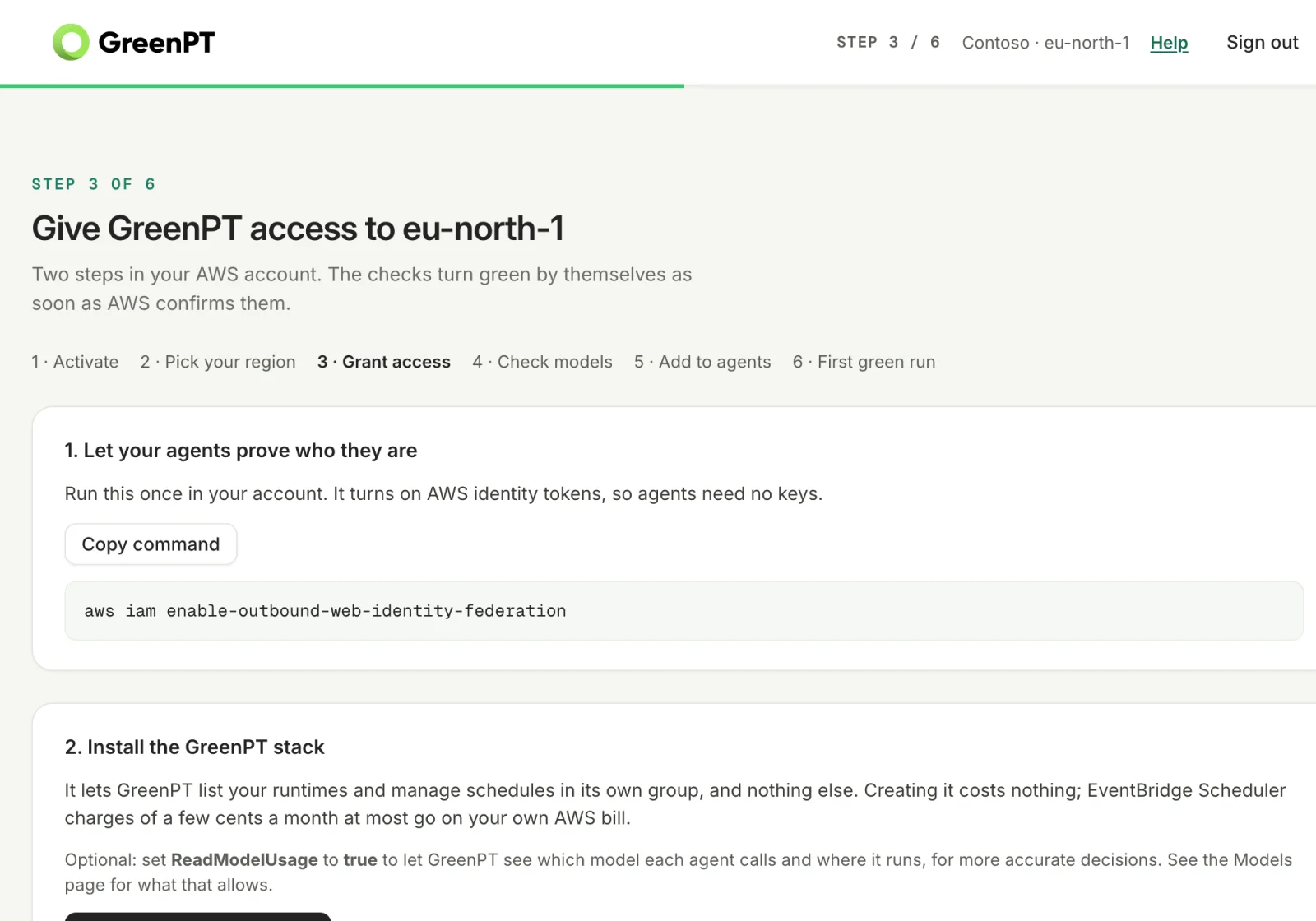
Granting access in the Bedrock set-up: one command and one stack. Illustrative data for Contoso.
Any other agent or scheduler
Everything else goes through the API and the MCP server: a Python scheduler, a cron job, a LangGraph or CrewAI agent, or an assistant you give the MCP tools to and let plan. They are in private beta.
How we keep the numbers honest
A carbon number is only useful if you know how far to trust it, so every answer says where it came from.
- Every figure has a kind.
measuredis the grid operator’s own figure.day_aheadandforecastare predictions, with p10 and p90 bands. A window is only as reliable as its least certain hour. - Gaps stay gaps. A window never spans an hour without data. When no complete window exists, the API says so instead of scheduling against invented numbers.
- It is checked against grid operators. Our figures match National Grid ESO’s for the UK exactly, RTE’s for France within 0.1 gCO₂/kWh and Fingrid’s for Finland within 3.4.
- US data runs behind. US grids are measured 12 to 20 hours behind real time, and every later hour is our own forecast. It times solar-driven grids such as California and Texas well, and wind-driven ones less well.
- Lifecycle by default. Intensity comes from each hour’s generation mix, with lifecycle emission factors per source. Direct, combustion-only factors are available too.
The grid data comes from public sources: the ENTSO-E Transparency Platform for Europe, National Grid ESO for Great Britain and EIA-930 for the United States.
Ask for early access
The Carbon & Price Aware API and MCP are in private beta. If your agents or batch jobs can wait a few hours, they can run on cleaner power, with a price on every run before it starts.
Ask for early access and tell us what you would like to schedule.
Frequently asked questions
What is the Carbon & Price Aware API?
A REST API and MCP server that answers three questions before a job runs: how clean the electricity is, when and where it will be cleanest before your deadline, and what the run will cost in tokens. Your code or your agent decides; the API supplies the facts.
Does waiting make my agent slower?
Only work you mark as flexible waits. You set the deadline, and every window ends before it. When no later hour is cleaner than now, the answer is run_now: true and the job starts straight away.
What happens when there is no forecast?
The run goes ahead. Missing data never holds up work, and the API never schedules against an hour it has no figure for.
How much does it save?
On measured grid data from 5 October to 5 November 2026, a one-hour run that waited up to 24 hours for a greener start typically used 27% less CO₂ per kWh in Europe and 21% less in the United States. This looks back at measured data, so it is a best case: forecasts catch most of that saving, not all of it.
Which agents can use it?
Microsoft Foundry agents and Amazon Bedrock AgentCore agents, through a GreenPT tool that signs in with the agent's own cloud identity. Any other agent, through the MCP server, and any scheduler, through the REST API. The API and MCP are in private beta.
How do I get access?
Ask for early access on the Carbon & Price Aware API page at greenpt.com/carbon-aware-api.
Continue reading
Product
One request, a whole task: inside Mangrove
Mangrove is GreenPT's orchestration endpoint. Send one request, and it plans the task, uses the tools, checks its own answer and reports its energy.
Read article
Product
Meet Metis Hybrid: one model that decides, explains and chats
Metis Hybrid is GreenPT's new decision model: it decides in about 60 milliseconds with a probability per option, explains itself and also chats.
Read article
Product
GreenPT is now available on Eden AI
Eden AI routes requests by cost, performance and region. GreenPT adds open-weight models that are processed and kept in the EU, on renewable energy.
Read article