

Product
GLM-5.3 and GLM-5.3 Flash on GreenPT
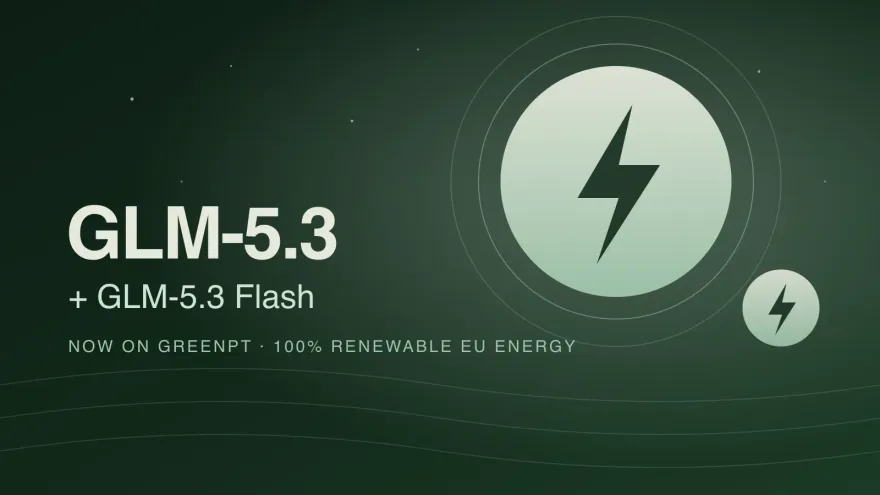
z.ai's GLM-5.3, the strongest open-weight coding model, and its 320B Flash sibling with vision are now on GreenPT: renewable EU hosting, 1M-token context, full privacy.

Two new z.ai models are live on GreenPT today: GLM-5.3, the strongest open-weight coding model available, and GLM-5.3 Flash, a smaller multimodal sibling that costs a tenth as much. Both run on 100% renewable European energy through our OpenAI-compatible API, with a 1M-token context and no training on your data.
GLM-5.3: same base, better training
z.ai released GLM-5.3 on 14 August 2026 with an unusual recipe. The base model is unchanged from GLM-5.2, the 753B mixture-of-experts model that has been our flagship coding model since we launched GreenPT Code. Instead of scaling parameters, z.ai scaled post-training: more environments, more diverse tasks, and more compute spent on reinforcement learning.
The result is a model that is both stronger and more economical per task:
- Z.ai Code Bench rises from 23.4% to 34.5% at max effort, a 50% relative gain, while output tokens per task drop from roughly 96,000 to 75,000.
- Terminal-Bench 3.0 climbs from 4.6 to 28.3 and DeepSWE v1.1 from 46.2 to 66.9, close behind Kimi K3 and Claude Fable 5.
- CyberGym, a vulnerability-discovery benchmark, reaches 84.5%, the top open-weight result, and one z.ai says it did not plan for.
That last point is why the weights arrived two weeks after the API. z.ai held them for a cybersecurity evaluation, and the model turned up 2,436 vulnerabilities across 269 open-source projects during that review, 1,097 of them medium-to-high severity. The weights went public on Hugging Face on 28 August under z.ai’s own licence rather than MIT.
For most teams the practical summary is simple: GLM-5.3 does what GLM-5.2 did, better, at the same price, and it spends fewer tokens getting there. It is our flagship coding model from today, and the default we recommend in every coding-agent guide.
GLM-5.3 Flash: 18B active, with eyes
GLM-5.3 Flash, released on 26 August, is a different model rather than a distilled one. It is a 320B mixture-of-experts system that activates 18B parameters per token, routing each token through 8 of 288 experts, and it is the first GLM-5 model with native image and video input.
Three architectural choices make it cheap to run:
- Hybrid attention. Kimi Delta Attention linear layers alternate with sparse attention layers, which z.ai reports as roughly 3× less attention compute and a 4.4× smaller KV cache.
- IndexPool compression keeps million-token retrieval tractable.
- Native FP8 weights with one multi-token-prediction draft layer, so the published checkpoint is already the efficient one.
The benchmarks land closer to the flagship than the parameter count suggests: 84.3 on Terminal-Bench 2.1 (Claude Opus 4.8 scores 85.0), 63.4 on DeepSWE v1.1, and 29.0 on Z.ai Code Bench, against the flagship’s 34.5. The weights are on Hugging Face under the MIT licence.
Active parameters are the number we care about at GreenPT, because they set the energy per token. Eighteen billion is less than half of what GLM-5.2 activates, and our per-request energy estimates for glm-5.3-flash reflect that.
Reasoning you control
Both models think by default, and both accept the same five reasoning_effort values on our API: none, minimal, low, medium, and high. Quick lookups stay cheap; an overnight refactor gets the deliberation it needs. Because reasoning is on by default, give the Flash model enough output budget for it. Full details are in the reasoning docs.
Open weights, European energy
We host open-weight models ourselves in green EU data centres. Running GLM-5.3 or GLM-5.3 Flash on GreenPT means:
- 100% renewable energy, with CO2 and energy usage reported per API call.
- EU processing and GDPR compliance, with data processing agreements on request.
- No training on your data. Not opt-out. Never.
- One API. Both models sit next to kimi-k3, glm-5.2, and the rest of the catalog.
| Model | Input | Cached input | Output |
|---|---|---|---|
| glm-5.3 | €1.10 | €0.275 | €4.40 |
| glm-5.3-flash | €0.11 | €0.022 | €0.44 |
Prices are per million tokens. glm-5.2 stays available at the glm-5.3 price, together with its Caveman, Ponytail, and Honey compression variants.
Try them
Point any OpenAI-compatible tool at our endpoint and select a model:
Base URL:  https://api.greenpt.ai/v1
API key:   GREENPT_API_KEY
Model:     glm-5.3   (or glm-5.3-flash)
Start a free 14-day trial, no credit card needed: create an account, pick glm-5.3 or glm-5.3-flash, and you are running the best open-weight coding model on renewable energy. Full specs live in the model docs.
Frequently asked questions
What is the difference between GLM-5.3 and GLM-5.3 Flash?
GLM-5.3 is z.ai's flagship: the 753B GLM-5.2 base with heavily scaled post-training, built for agentic coding and tool use. GLM-5.3 Flash is a separate, smaller 320B model that activates 18B parameters per token, adds native image and video input, and costs a tenth of the price. Both read 1M tokens of context and support the same reasoning-effort levels.
How much do GLM-5.3 and GLM-5.3 Flash cost on GreenPT?
GLM-5.3 is €1.10 per million input tokens, €0.275 for cached input, and €4.40 per million output tokens. GLM-5.3 Flash is €0.11 input, €0.022 cached, and €0.44 output. Both are served from renewable EU infrastructure through the OpenAI-compatible GreenPT API.
Are the GLM-5.3 models open-weight?
Yes. GLM-5.3 Flash was published on Hugging Face under the MIT licence on 26 August 2026. GLM-5.3 followed on 28 August under a bespoke z.ai licence, after a two-week hold for cybersecurity evaluation. Both run on GreenPT so you do not need to host them yourself.
Which one should I use for a coding agent?
Start with glm-5.3 for long agentic sessions, hard refactors, and anything where correctness per token matters. Use glm-5.3-flash for routine edits, high-volume pipelines, and any task that involves screenshots or video, where it delivers most of the flagship's capability at a tenth of the cost.
Continue reading

Product
GreenPT is now available on Eden AI
Eden AI routes requests by cost, performance and region. GreenPT adds open-weight models that are processed and kept in the EU, on renewable energy.
Read article
Product
Meet Metis: a decision model that weighs every answer
Metis is GreenPT's decision model. Give it a case and your rules, and it returns a probability for every possible answer in one pass, hosted in the EU.
Read article
Product
GreenPT is now available on LLMTR
GreenPT's EU-hosted, open-weight models are now available through LLMTR, a Turkish AI gateway. Same LLMTR API, with inference in the EU.
Read article